
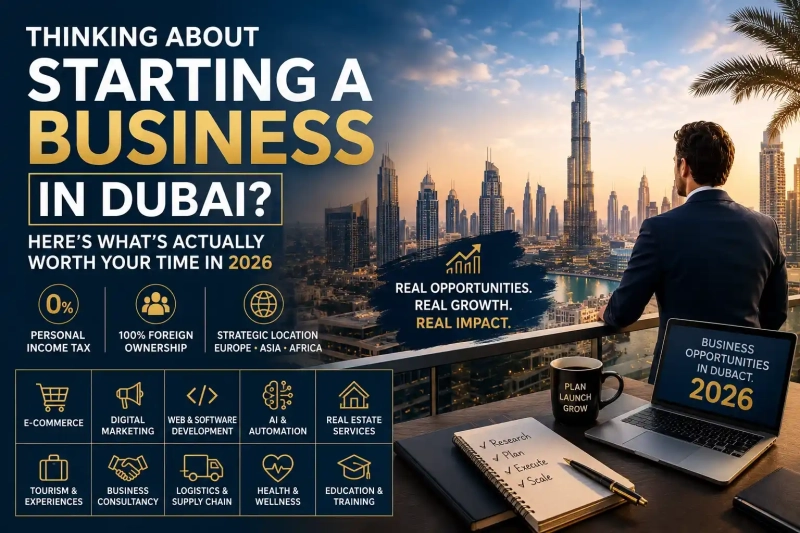
If you've spent any time researching where to set up a business, Dubai has probably come up more than once — and for good reason. Between the lack of personal income tax, the ease of getting 100% foreign ownership in most sectors, and a location that puts you within a few hours' flight of Europe, Asia, and Africa, it's not hard to see why so many founders, freelancers, and investors keep ending up here.
But "Dubai is a great place to do business" is the kind of thing everyone says, and it doesn't actually help you decide what to do once you arrive. So let's get into the specifics — what's working right now, what's likely to keep working, and what to watch out for before you sign a lease or apply for a license.
What Makes Dubai Different
A lot of cities talk about being business-friendly. Dubai has actually built the infrastructure to back it up. The logistics network is world-class, the regulatory environment moves fast compared to most places, and the digital economy here has grown to the point where almost any service-based business can find customers within months of launching. Add in a steady stream of new residents and tourists, and you've got a market that rewards people who show up with a real plan rather than just an idea.
That said, plenty of businesses still fail here — usually not because Dubai didn't deliver, but because the founder picked a crowded niche, underpriced their services, or never bothered to figure out who their customer actually was. More on that later.
The Industries Where People Are Actually Making Money
E-Commerce Is Still Growing — But Pick Your Niche Carefully
Online shopping in the UAE and across the Gulf hasn't slowed down, and honestly, it's easy to see why. People here are comfortable paying online, delivery infrastructure is solid, and there's a real appetite for brands that feel a step above generic.
Fashion, beauty, electronics, home décor, fitness gear, and baby products all continue to perform well, and you don't need a warehouse full of inventory to get started — dropshipping and private-label models let you test demand before committing serious capital. The catch is that "e-commerce" on its own isn't a business plan anymore. The people doing well have a specific product, a specific customer, and a reason that customer would choose them over the dozens of similar stores already running ads on the same platforms.
Digital Marketing Agencies Are Busy, and Likely to Stay That Way
Almost every business in Dubai — restaurants, clinics, real estate firms, retail brands — knows it needs to be visible online, and most of them don't have the in-house skills to do it well. That gap is where marketing agencies thrive.
If you know your way around SEO, paid ads, content, or social media management, there's real demand here. The agencies that struggle tend to be the ones trying to be everything to everyone. The ones that do well usually pick a lane — say, lead generation for real estate brokers, or social media for clinics — and become the obvious choice within that niche.
Web and Software Development Still Has Room to Run
Dubai's push toward digital transformation means companies across every sector are looking for help with websites, mobile apps, CRM systems, and automation tools. If you're a developer or run a small dev shop, this is one of the more durable opportunities on this list — not flashy, but consistently in demand because businesses here are actively trying to modernize how they operate.
Agencies like DesignZeros, based out of Dubai Internet City, are a good example of how this plays out in practice — building custom websites and software solutions for startups, brands, and growing businesses across the UAE. If you're weighing whether there's still room for another development shop in this market, the steady stream of agencies like this finding work is a decent signal that the demand is real and ongoing.
AI and Automation: Less Hype, More "Can You Actually Build This"
AI gets thrown around a lot in business conversations these days, and Dubai is no exception — but what's interesting is that the demand here is increasingly practical rather than experimental. Companies want chatbots that actually handle customer questions, workflow automation that removes manual steps, and tools that help with sales follow-up or content production.
If you can walk into a business, look at how they're currently doing something manually, and show them a working automation that saves real hours, you're solving a problem people are willing to pay for — right now, not someday.
Real Estate Services Beyond Just Selling Property
Dubai's property market keeps attracting global investors, and that creates opportunities well beyond the obvious brokerage route. Property management, short-term rental management (especially for investors who don't live in the UAE), real estate marketing, and investment consulting are all areas where specialized knowledge is in short supply relative to demand.
Tourism Still Means Big Numbers, but Generic Tours Are a Tough Sell
Millions of visitors come through Dubai every year, and that's not changing. What is changing is what those visitors expect — generic city tours are everywhere, but curated, niche experiences (luxury, adventure, corporate travel, event-based tourism) tend to command better margins and attract repeat business.
Business Consultancy: Helping People Avoid the Mistakes Below
New entrepreneurs arriving in the UAE often have no idea where to start with licensing, free zone selection, compliance, or financial planning — and getting it wrong can be expensive. A consultancy built around guiding people through this process has relatively low overhead and can be genuinely valuable, provided you actually know the regulatory landscape inside and out.
Logistics Keeps Growing Alongside E-Commerce
Every new online store needs someone to get the product to the customer, which means last-mile delivery, warehousing, freight forwarding, and supply chain consulting are all riding the same wave as e-commerce. Dubai's position as a regional hub only strengthens this.
Health, Wellness, and the Shift Toward Prevention
People here are paying more attention to fitness, nutrition, and overall wellbeing, and that's translating into demand for gyms, wellness coaching, healthy meal delivery, physiotherapy, and corporate wellness programs. It's a steady-growth category rather than an explosive one, but steady growth with loyal customers is nothing to dismiss.
Education and Training Aren't Going Anywhere
Whether it's language courses, IT certifications, business skills training, or corporate upskilling programs, there's consistent demand from both individuals trying to advance their careers and companies trying to keep their teams competitive.
Three Sectors Worth Keeping an Eye On
A few areas aren't yet as crowded as the ones above, but they're moving in a direction that suggests they'll matter a lot more soon.
Sustainability and green business. The UAE's sustainability push is creating real demand for solar energy solutions, energy efficiency consulting, and recycling services. This is early-stage in terms of competition, which makes it interesting for anyone willing to build expertise now.
Fintech. Digital payments, lending platforms, and investment technology are all benefiting from a regulatory environment that's more supportive of fintech innovation than many other markets.
Cybersecurity. As more businesses move operations online, security assessments, compliance consulting, and managed security services are becoming less of a nice-to-have and more of a requirement — which is good news if you're in this space.
So, What Does It Actually Cost?
This is where a lot of plans fall apart, because people budget for the license and forget everything else. Here's a rough sense of what to expect:
| Expense | Estimated Cost (AED) |
|---|---|
| Business License | 5,000 – 20,000+ |
| Office Space | 5,000 – 50,000+ |
| Visa Costs | 3,000 – 7,000+ |
| Marketing | Variable |
| Operational Expenses | Variable |
Free zones remain the most common starting point for new entrepreneurs, mainly because they simplify the setup process and tend to come with lower upfront costs than mainland licensing.
The Mistakes That Sink Otherwise Good Businesses
None of these are unique to Dubai, but they show up here constantly:
Skipping market research. Plenty of people choose a business because it sounds exciting or because they read it was "trending," without checking whether there's actual demand — or whether ten other businesses just like it already exist nearby.
Underestimating ongoing costs. The license fee is just the entry ticket. Marketing, salaries, software subscriptions, and compliance requirements add up fast, and a lot of founders only account for these after they've already run short on cash.
Treating marketing as optional. Even a genuinely excellent business can struggle to get noticed if nobody's actively building visibility for it. This isn't a "nice to have later" — it needs to be part of the plan from day one.
Trying to appeal to everyone. The businesses that do well almost always serve a specific kind of customer with a specific kind of problem. "Everyone" is not a target market, and trying to market to everyone usually means resonating with no one.
If You're Starting From Zero, Where Should You Look First?
For first-time founders, the lowest-barrier paths tend to be service-based: digital marketing, web development, consultancy, content creation, online education, and AI automation services. These require less upfront capital than retail or hospitality, and they let you start small, prove the model works, and reinvest as you grow — rather than betting everything on a big launch.
Where Dubai Is Headed
If there's a common thread across everything above, it's that Dubai's economy is leaning hard into technology, sustainability, fintech, and international trade — and businesses that align with those directions tend to find the wind at their back rather than against it.
None of this means success is guaranteed, and it certainly isn't automatic. But the fundamentals here — infrastructure, market access, and a genuine appetite for new ideas — are about as strong as you'll find anywhere. The businesses that do best aren't necessarily the ones chasing the most popular trend; they're the ones that found a real gap, tested it properly, and stuck with it long enough to build something people actually rely on.