
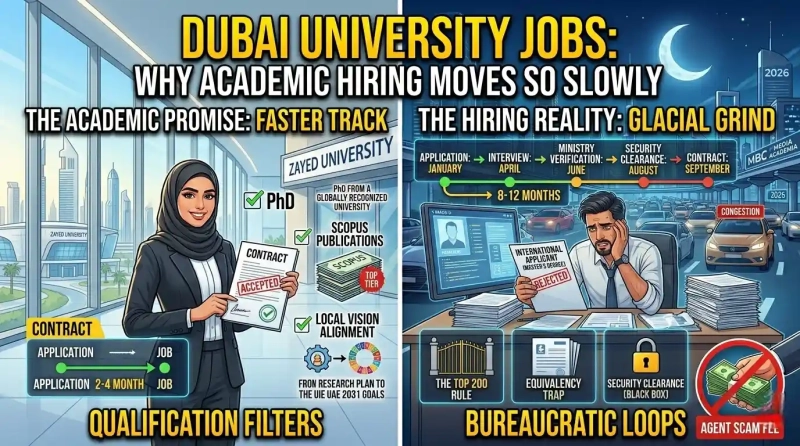
If you’re applying for dubai university jobs, I hope you’ve got a good hobby to keep you busy. Seriously. Whether you're targeting faculty roles at Zayed University or research spots that sound as fancy as dubai jobs german (language specialist roles) or mbc jobs dubai (media academia), the timeline is... well, glacial.
In 2026, academic hiring in the UAE has become even more layered. It’s not just about your PhD anymore; it’s about a massive bureaucratic machine. Here’s why your application feels like it’s stuck in a time loop.
Reality check: slow hiring is the norm
In most industries, you interview and start in three weeks. In academia? If you apply in January, don't be shocked if you aren't standing in a lecture hall until August.
Universities here plan in "cycles." Most hiring for the Fall semester (August/September start) happens between January and May. If you’re applying in June, you’re usually too late for this year and too early for the next. You're basically shouting into an empty hallway.
Academic ranking and qualification filters
The "Hidden Rule" of 2026: The Top 200 Rule. Many top-tier Dubai unis now have a silent filter—they prioritize candidates whose terminal degree (PhD) is from a university ranked in the global top 200 (QS or Times Higher Education).
-
PhD vs. Masters: If you only have a Master’s, you’re mostly restricted to "remedial" or "freshman" levels unless you have 8+ years of heavy-duty industry experience.
-
The "Scopus" Obsession: It’s publish or perish, but specifically in Scopus-indexed journals. If your research is on a personal blog or a non-indexed journal, it’s like it doesn't exist to the search committee.
Why international applicants struggle
It’s the "Equivalency" trap. By the time a university in Dubai likes you, they have to get your degree "equated" by the Ministry of Education. This involves verifying every single year of your schooling. If you’re an international applicant and your home country’s embassy is slow with paperwork, the university might just move to the next person on the list who is already "vetted."
Interview cycles explained
It’s usually a three-act play:
-
The Committee Filter: A group of professors rejects 90% of the pile.
-
The "Job Talk": You’ll likely have to give a guest lecture or present your research via Zoom (or in person). They’re checking if you’re boring. Don’t be boring.
-
The Security Clearance: This is the black box. Even after the Dean says "Yes," you wait 2-4 weeks for a government background check. Only then do you get the contract.
How to improve academic job chances
-
Network at Gitex/Expos: Many academic departments scout for tech-heavy faculty at major Dubai trade shows. Be there.
-
The "Research Statement": Don't make it generic. Mention how your research aligns with the UAE 2031 Vision or local sustainability goals. Show them you aren't just here for the tax-free salary.
-
Check the "International" Deadline: As we saw this year, international deadlines are often 2 months earlier (around mid-June for Fall) than for people already in the UAE.
Keep an eye on the Dubai job interview timeline—it’s longer here than you think. And for the love of all things holy, ignore "professors" on LinkedIn asking for "processing fees" to submit your paper to a university board. It’s a classic move in the world of job scams awareness.
Still waiting on a response from a February application? You’re not alone. Let’s vent in the comments.