Everyone Has Heard of It. Very Few People Understand What It Actually Is.
Ask most people in Dubai what the Airport Free Zone is and you get a vague answer involving tax benefits and somewhere near the airport. Ask a business owner who has been through the setup process and you get a very different conversation — one that involves timelines, costs, documentation requirements, and a realistic picture of what the free zone delivers versus what the promotional material promises.
The Dubai Airport Free Zone — officially DAFZ, Dubai Airport Free Zone Authority — is one of the UAE's most established free zones. It has operated since 1996, houses hundreds of international companies, and sits within one of the world's busiest airport corridors. For the right type of business, it offers genuine advantages. For the wrong type, it is an expensive administrative commitment that delivers less than alternatives would.
The gap between what DAFZ marketing says and what the actual setup experience involves is wide enough to warrant a clear, unvarnished breakdown. That is what this guide is.
Reality Check: Free Zone Setup Is Not Fast, Cheap, or Simple — And DAFZ Is No Exception
The first thing most people are told about UAE free zones is that setup is quick — sometimes described as taking just a few days. For a basic trade licence in a straightforward category, this is technically possible. For most real business setups involving office space, employee visas, and operational approvals, it is not.
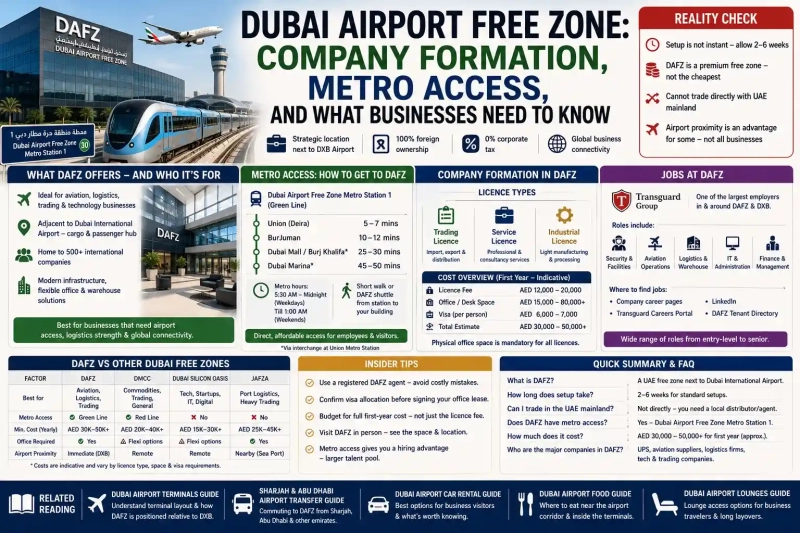
Company formation in Dubai Airport Free Zone involves a multi-step process that includes initial application, licence category selection, office or desk space commitment, visa allocation, and regulatory approvals. Depending on business type and documentation readiness, the realistic timeline runs from 2 to 6 weeks. Businesses requiring special approvals — those in aviation, logistics, or regulated trade — can take longer.
The second misconception: that free zone formation is significantly cheaper than mainland company formation. DAFZ is one of Dubai's more premium free zones — positioned around a prestige address and strong infrastructure rather than the lowest-cost entry point. Licence fees, office space commitments, and visa costs at DAFZ are higher than at several other UAE free zones. Businesses whose primary motivation is minimising setup cost will find better options elsewhere in the UAE free zone landscape.
The third reality: a DAFZ company cannot directly trade with the UAE mainland market without a local distributor or agent arrangement. This is a fundamental free zone limitation across the UAE — not specific to DAFZ — but it catches businesses who assume that a UAE company registration means unrestricted UAE market access. If direct mainland trading is a core business requirement, a mainland licence is the more appropriate structure.
What DAFZ Actually Offers — And Who It Is For
The Core Proposition
DAFZ's genuine strength is its positioning. It sits adjacent to Dubai International Airport — one of the world's highest-traffic cargo and passenger hubs — and offers direct proximity to air freight, logistics operations, and the network of aviation, trade, and distribution companies that cluster around that infrastructure.
Dubai Airport Free Zone companies are concentrated in four primary sectors: aviation and aerospace, logistics and freight, technology, and trading. The free zone's physical proximity to the airport's cargo terminals makes it a genuinely practical base for companies whose operations are tied to air cargo movement, aircraft parts supply, aviation services, and time-sensitive international trade.
For a company in these sectors, the DAFZ address and the operational advantages of airport proximity are real and measurable. For a company in professional services, media, or retail — sectors where the airport adjacency delivers no operational benefit — the premium pricing of a DAFZ setup is difficult to justify against alternatives like DMCC, DIFC, or Dubai Silicon Oasis.
Dubai Airport Free Zone Companies List — Who Is Actually There
The Dubai Airport Free Zone companies list spans a wide range of industries, but the anchor tenants reflect the free zone's core positioning. Major global logistics and freight operators, aviation supply companies, technology distributors, and international trading houses form the backbone of the DAFZ tenant community.
UPS Dubai Airport Free Zone (UPS DAFZ) is one of the most prominent logistics names in the free zone — operating a full logistics and freight management function from its DAFZ base. The UPS presence reflects exactly the type of business DAFZ is designed for: a global logistics operator that needs direct airport access, bonded warehousing capability, and proximity to air cargo infrastructure.
Other notable categories represented include pharmaceutical importers and distributors, electronics trading companies, aviation parts suppliers, and a range of mid-size international companies using DAFZ as their UAE and regional headquarters base.
Getting to DAFZ: Metro Access Explained
Dubai Airport Free Zone Metro Station
One of DAFZ's most practical logistical advantages is its metro connectivity. The Dubai Airport Free Zone metro station — formally called Dubai Airport Free Zone Metro Station 1 Dubai — sits on the Green Line of the Dubai Metro network.
The station provides direct metro access to DAFZ without requiring a car or taxi for employees commuting from central Dubai. For a free zone, this is a meaningful practical advantage — many of Dubai's other free zones require a car commute, making daily employee access more complex and costly.
Metro journey times from key Dubai locations to DAFZ:
- Union Metro Station (Deira): approximately 5–7 minutes
- BurJuman: approximately 10–12 minutes
- Dubai Mall / Burj Khalifa (via interchange): approximately 25–30 minutes
- Dubai Marina (via interchange at Union): approximately 45–50 minutes
The Green Line runs from approximately 5:30 AM to midnight on weekdays and until 1 AM on weekends. For employees working standard business hours, the metro schedule aligns well with the commute requirement.
Practical note: the metro station entrance is at the DAFZ perimeter. From the station, access to specific buildings within the free zone involves a short walk or an internal DAFZ shuttle. Visitors attending meetings inside DAFZ for the first time should confirm the building location and internal access route before arriving — the free zone campus is larger than it appears from the metro exit.
Company Formation at DAFZ — The Process in Plain Terms
Licence Types Available
DAFZ offers three primary licence categories:
Trading Licence: for companies importing, exporting, and distributing goods. This is the most common licence type at DAFZ and covers a wide range of product categories subject to approval.
Service Licence: for companies providing professional or consultancy services. Scope of permitted services is defined at application and cannot be freely expanded after issuance without amendment.
Industrial Licence: for light manufacturing, assembly, and processing operations. Available with warehouse and workshop space commitments.
Each licence type has specific documentation requirements, minimum capital commitments, and activity restrictions. Selecting the wrong licence type at formation is a common and costly mistake — amendments take time and incur fees.
Office Space Requirement
Unlike some UAE free zones that offer "flexi-desk" or virtual office options at low entry costs, DAFZ requires a physical space commitment from all licence holders. Options range from desk space in a shared business centre through to dedicated offices and warehouse units.
Desk space (the minimum commitment): approximately AED 15,000–25,000 per year depending on configuration. Private office: approximately AED 40,000–80,000 per year depending on size. Warehouse units: priced by square footage, typically starting from AED 60,000 per year for the smallest available units.
These costs are on top of the licence fee and visa costs. The total annual commitment for a basic DAFZ setup runs from approximately AED 30,000–50,000 at the minimum entry level — before any employee visa costs are factored in.
Visa Allocation
Each DAFZ company receives a visa allocation based on the office space taken. The minimum desk allocation typically permits 1–2 employee visas. Larger offices increase the allocation. For businesses planning to bring multiple employees into the UAE under the DAFZ entity, the office space commitment and visa allocation need to be planned together — discovering that the chosen space allows only 2 visas when the business needs 6 means a space upgrade and a higher annual commitment.
Jobs at Dubai Airport Free Zone — Working in DAFZ
Transguard jobs in Dubai Airport represent one of the most visible employment categories within the DAFZ ecosystem. Transguard Group — one of the UAE's largest business support, security, and manpower companies — has a significant operational presence both within DAFZ and across Dubai International Airport. They hire across a wide range of roles from security and facility management through to aviation ground support and technology services.
For job seekers interested in working within or around DAFZ, the primary hiring channels are:
- Direct applications through DAFZ-registered companies' own career pages
- Transguard's careers portal for roles across airport and free zone operations
- LinkedIn, which carries a high volume of DAFZ-registered company postings
- The DAFZ Authority's own tenant directory, which lists registered companies and their contact details
Roles within DAFZ span the full spectrum from entry-level warehouse and logistics positions through to senior management in trading, aviation services, and technology. Salary ranges reflect the professional nature of the free zone and the international tenant mix — generally above UAE average for equivalent roles in less prestigious free zones.
DAFZ vs Other Dubai Free Zones — A Brief Comparison
| Factor | DAFZ | DMCC | Dubai Silicon Oasis | JAFZA |
|---|---|---|---|---|
| Best for | Aviation, logistics, trading | Commodities, trading, general | Tech, startups | Port logistics, heavy trading |
| Metro access | Yes (Green Line) | Yes (Red Line) | No | No |
| Minimum cost | AED 30,000–50,000/year | AED 20,000–40,000/year | AED 15,000–30,000/year | AED 25,000–45,000/year |
| Physical office required | Yes | Flexi options available | Flexi options available | Yes |
| Airport proximity | Immediate (DXB) | Remote | Remote | Nearby (sea port) |
For businesses where airport proximity is operationally irrelevant, DAFZ's cost structure is harder to justify against more flexible alternatives. For businesses genuinely tied to air freight and aviation infrastructure, DAFZ's positioning advantage is real.
Insider Tips for DAFZ Company Formation
Use a registered DAFZ formation agent for the initial application. The documentation requirements and activity code selection process benefit significantly from someone who has submitted multiple DAFZ applications. Mistakes at the application stage — wrong activity code, incomplete documentation — delay the process and incur amendment fees that a good agent's fee would have prevented.
Clarify visa allocation before committing to your office space. The link between office size and visa allocation is the most commonly misunderstood aspect of DAFZ formation. Get written confirmation of the visa allocation for your chosen space before signing the lease.
Budget for the full first-year cost, not just the licence fee. Licence fee plus office space plus visa costs plus PRO (Public Relations Officer) service fees plus bank account setup costs. The total first-year spend is typically 40–60% higher than the licence fee alone.
Visit the free zone in person before committing. DAFZ runs business setup information sessions and allows prospective tenants to tour the facilities. Seeing the space, the building quality, and the commute from the metro station gives you a more accurate picture than any brochure.
Metro access is a genuine hiring advantage. When recruiting UAE-based talent, the DAFZ metro connection meaningfully expands the pool of candidates willing to commute. For free zones without metro access, car dependency limits the practical catchment area for employees who do not drive.
Quick Summary and FAQ
What is the Dubai Airport Free Zone (DAFZ)? DAFZ is a UAE free zone established in 1996 adjacent to Dubai International Airport. It houses hundreds of international companies primarily in aviation, logistics, trading, and technology sectors.
How long does company formation in Dubai Airport Free Zone take? Realistically 2–6 weeks for straightforward setups. Regulated industries requiring special approvals may take longer.
What does a basic DAFZ company setup cost? Approximately AED 30,000–50,000 for the first year at minimum entry level, covering licence fee, desk space, and basic administrative costs before visa expenses.
Does DAFZ have metro access? Yes. The Dubai Airport Free Zone Metro Station on the Green Line provides direct access from central Dubai without requiring a car.
Can a DAFZ company trade directly with the UAE mainland? Not directly. A local distributor or agent arrangement is required for mainland market access, as with all UAE free zones.
What companies are in DAFZ? Aviation suppliers, logistics and freight operators (including UPS), electronics distributors, pharmaceutical importers, and a wide range of international trading companies.
Related Reading
For businesses visiting the free zone for meetings or site tours, the Dubai Airport terminals guide covers the road layout around Dubai International Airport and how the free zone's position relates to each terminal building — useful context for visitors arriving by taxi or private transfer from the airport itself.
Understanding how to get to and from DAFZ connects directly to the broader transport picture around Dubai Airport. The Sharjah and Abu Dhabi Airport transfer guide covers intercity transport options that affect employees and visitors commuting into the DAFZ area from outside Dubai — particularly relevant for businesses considering staff who live in Sharjah, which has a significant commuter population working in the DXB corridor.
For business visitors flying into Dubai for DAFZ meetings who need a vehicle, the Dubai Airport car rental guide covers which terminal desks to use, how to avoid the standard counter upsells, and when an airport transfer is more practical than renting a car for a short business trip.
Visitors spending time near DAFZ between meetings and looking for dining options near the airport corridor should check the Dubai Airport food guide for the terminal options — or the Dubai Airport lounges guide if their airline ticket or credit card provides lounge access worth using during a wait between flights.